
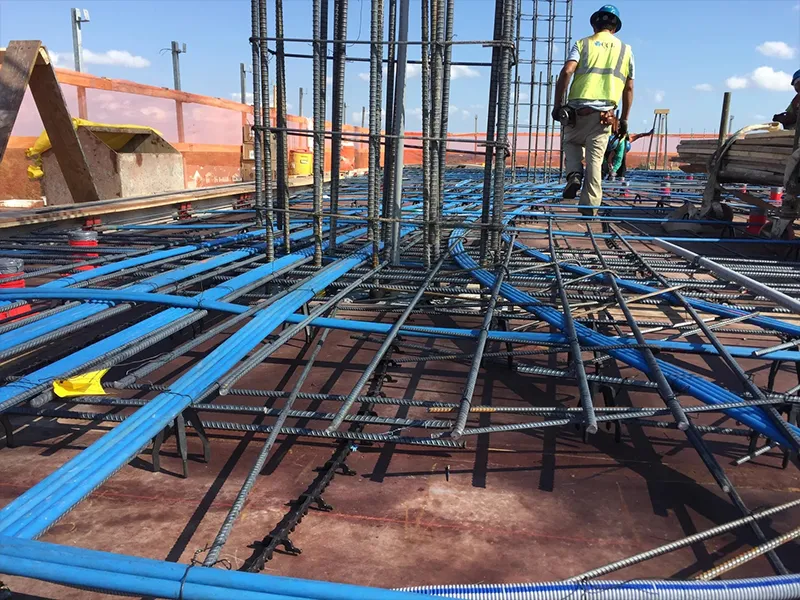
What Is Post-Tensioning and Why Does It Matter?
In the ever-evolving world of construction engineering, few innovations have had as profound an impact as post-tensioning systems. This advanced structural technology represents a paradigm shift in how we design and build everything from residential towers to massive infrastructure projects.
Post-tensioned concrete is a specialized form of prestressed concrete where high-strength steel tendons are tensioned after the concrete has been cast and has achieved sufficient strength. The tendons are anchored against the concrete, introducing beneficial compressive stresses that dramatically improve the structural performance of the member.
Unlike conventional reinforced concrete — where steel reinforcement passively resists tension after cracks have already formed — post-tensioning is an active system that pre-compresses the concrete before service loads are applied. This means the concrete remains largely uncracked and structurally efficient throughout its entire service life.
How Post-Tensioning Works: The Science Behind the Strength
The Fundamental Principle
The core philosophy of post-tensioning can be expressed in a simple equation:
Pre-Compression + Tension (from loading) = Near-Zero Net Stress
Think of it this way: imagine trying to lift a row of books horizontally. Without compression, the books separate and fall apart. But when you squeeze them together firmly, the entire row behaves as a single, stiff unit that can span across a gap. This is exactly what post-tensioning does to concrete.
The Process Step by Step
- Formwork and Reinforcement: Standard formwork is erected and conventional reinforcement mesh is placed as the bottom layer.
- Tendon Placement: High-strength steel tendons (typically 7-wire strands) are positioned within ducts along a carefully designed profile.
- Concrete Casting: Concrete is poured and allowed to cure until it reaches the required compressive strength.
- Stressing: Hydraulic jacks are used to tension the tendons to the design force, typically between 70% and 80% of the tendon ultimate strength.
- Anchoring: The tendons are locked off at the anchorage points, transferring the compressive force permanently into the concrete.
- Grouting (bonded systems): In bonded post-tensioning, grout is injected into the ducts to provide corrosion protection and bond between tendon and concrete.
Reinforced Concrete vs. Post-Tensioned Concrete: A Clear Comparison
Understanding the difference between these two approaches is crucial for anyone involved in construction decision-making:
Reinforced Concrete (Traditional)
- Steel reinforcement is passive — it only works after cracks form
- Cracks develop under normal service loads
- Deflection increases over time due to creep and shrinkage
- Requires thicker structural members for longer spans
- Higher material consumption (concrete and steel)
- Durability can be compromised by cracking
Post-Tensioned Concrete (Advanced)
- Prestressing is active — concrete is pre-compressed before loading
- Cracks are prevented or significantly reduced
- Deflection is controlled through balancing loads with prestress
- Enables thinner slabs and longer spans
- Significant material savings
- Superior durability and serviceability
The 14 Key Advantages of Post-Tensioning
Post-tensioning delivers a comprehensive range of benefits that impact every aspect of a construction project:
1. Increased Column Spacing and Architectural Freedom
Post-tensioned slabs can span significantly longer distances than conventional slabs, allowing for greater column spacing. This translates to more open floor plans, flexible interior layouts, and reduced visual obstructions — a major advantage for both residential and commercial developments.
2. Beam-Free Ceilings
Flat slab construction becomes easily achievable with post-tensioning, eliminating the need for deep beams that protrude below the ceiling line. This provides freedom for architectural changes on each floor and creates cleaner, more modern interior spaces.
3. Reduced Concrete Consumption
Slab thickness can be reduced by approximately 15% compared to conventional reinforced concrete. This reduction in concrete volume directly translates to material cost savings and reduced environmental impact.
4. Dramatic Steel Reduction
One of the most impressive advantages — post-tensioning can achieve up to 60% reduction in conventional steel reinforcement. The high-strength tendons carry the primary tensile forces far more efficiently than mild steel bars.
5. Simplified Formwork Systems
Thinner, uniform-depth slabs allow the use of simpler formwork systems, including table forms that can be quickly erected and stripped. This reduces formwork costs and improves construction efficiency.
6. Faster Formwork Removal
Because post-tensioning introduces immediate compression into the slab, formwork can be safely removed in as little as 7 days — compared to 21-28 days for conventional concrete. This dramatically accelerates floor cycle times.
7. Higher Structural Strength and Durability
The pre-compression from post-tensioning results in structures that are inherently stronger and more durable. Reduced cracking means better protection for embedded steel, leading to longer service life.
8. Enhanced Earthquake Resistance
Post-tensioned structures exhibit superior ductility and energy absorption capacity, making them better suited to seismic zones. The continuous tendons help hold the structure together even under extreme loading.
9. Ideal for Large-Span Buildings
Factories, warehouses, worship facilities, exhibition halls, and villas all benefit from the ability of post-tensioned systems to achieve large clear spans without intermediate supports.
10. Faster Construction Cycles
Overall construction timelines can be accelerated by 25% or more. The combination of faster formwork removal, simpler reinforcement, and efficient construction sequences all contribute to this acceleration.
11. Lighter Structures and Economical Foundations
Reduced slab thickness means lower building mass, which in turn reduces the loads on columns and foundations. This can result in significant savings in foundation design and construction.
12. Superior Crack Control
Post-tensioning provides excellent crack control by maintaining the concrete in compression under service loads. This is particularly important for structures that must remain watertight or those exposed to aggressive environments.
13. No Expansion Joints Required
The compressive forces introduced by post-tensioning can compensate for shrinkage and thermal movements, often eliminating the need for expansion joints in buildings up to 100 meters in length.
14. Overall Cost and Performance Efficiency
When all factors are considered — materials, labor, time, and lifecycle costs — post-tensioning delivers exceptional value. Real project data consistently shows total cost savings approaching 24% compared to conventional construction.
Real Project Comparison: The Numbers Speak
To illustrate the tangible benefits, consider a real comparison from the El-Hegaz Residential Building project:
| Parameter | Conventional RC | Post-Tensioned | Saving |
|---|---|---|---|
| Slab Thickness | 200 mm | 180 mm | 10% |
| Concrete Volume | 1,985 m³ | 1,787 m³ | 199 m³ |
| Steel Reinforcement | 248 tons | 95 tons | 153 tons (62%) |
| Total Project Cost | 14.59M L.E. | 11.11M L.E. | 3.49M L.E. (23.9%) |
These are not theoretical projections — they are actual quantities and costs from a completed project, demonstrating the dramatic savings that post-tensioning delivers in practice.
Execution Speed: A Typical Slab Cycle
For a typical 2,000 m² slab, the post-tensioning execution cycle takes just 1 to 1.5 days per segment:
- Day 1: Marking, lower mesh fixation, PT tendon installation
- Day 2: Upper mesh fixation, finishing PT installation
- Day 3: Concrete pouring, curing, and cube testing
- Day 4-7: Curing period and stressing operations
This rapid cycle time allows construction teams to maintain aggressive schedules while ensuring quality at every stage.
Applications Across Sectors
Post-tensioning is versatile and applicable across virtually every construction sector:
- High-Rise Residential: Thinner slabs mean more floors within the same building height — approximately one extra floor for every 20 floors compared to conventional construction.
- Commercial Complexes: Large column-free spans create flexible office and retail spaces that can be easily reconfigured.
- Infrastructure: Bridges, parking structures, and water tanks all benefit from the durability and span capabilities of post-tensioning.
- Industrial Facilities: Factories and warehouses require large clear spans that post-tensioning delivers efficiently.
- Residential Villas: Even smaller structures benefit from the crack control, reduced maintenance, and design flexibility offered by post-tensioning.
Ahalyna and MESC: Your Post-Tensioning Partner
At Ahalyna Group, we bring post-tensioning expertise refined across more than 30 projects in Saudi Arabia, Egypt, Sudan, and now Kenya. Through our technical arm — MESC (Modern Economic Solutions Company) — and our strategic partnership with SPS (Splitting Processing Systems), one of the world’s largest post-tensioning system suppliers based in Australia, we deliver:
- Certified, world-class post-tensioning materials and systems
- In-house structural design and engineering
- Complete value engineering analysis
- Full on-site execution and quality control
- Technical consultancy and training
The Bottom Line
Post-tensioning is not just an alternative construction method — it is a superior engineering solution that delivers measurable advantages in cost, time, quality, and performance. As construction demands become more complex and clients expect higher value, post-tensioning will continue to be the technology of choice for forward-thinking developers and engineers.
Whether you are planning a high-rise residential tower, a commercial complex, or an infrastructure project, post-tensioning can help you build better, faster, and more economically.
Contact Ahalyna Group today to discuss how post-tensioning can benefit your next project.
